By admin on Dec 26, 2008 | In Laptops, Software | 1 Comment »
 When you turn on your laptop, you notice that the colors on the screen are inverted – black is white, white is black and instead of blue you see orange. This is sometimes referred as negative mode or negative display. In addition to these symptoms, the picture is very dark/dim and it can flicker at low brightness. When you connect the laptop to an external display (PC monitor, TV) the picture is perfect, which means that the graphic card in the laptop works fine and the problem lies in the screen.
Two parts of the screen that can be replaced, the inverter and the backlight, are most probably not the causes of the malfunction. The inverter supplies the power to the screen – and there is power, and the backlight lights up every time too, so replacing these two won’t help. The real cause is unknown but the solution is: replace the whole screen. If your laptop is not under warranty and you don’t want to spend $200 for a new screen, you are left with two options: look for a used screen on eBay (which can take time, it may still be expensive and you’ll have to install it yourself) or use a software called Powerstrip.
Read the rest »
By admin on Dec 24, 2008 | In Hardware | No Comments »
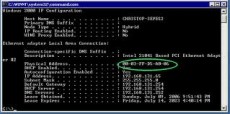 If you need to find the MAC address of your PC, then you can do this by following these steps:
- open the Command Prompt (Start, Run and type cmd, click OK)
- in the cmd window, type ipconfig /all
- this will display the detailed configuration of your network adapters
- If you only have an ethernet adapter, look for the first Physical Address entry. It will have 6 pairs of hexadecimal digits (letter/number combinations), separeted by hyphens (-) or colons (:)
- If you use a wireless connection, make sure you read the MAC address of the wireless adapter. If you are not sure where to look, read the description field above the Physical Address entry. It should include the name of the adapter
MAC addresses (also known as hardware or physical addresses) are unique identifiers of network adapters and network interface cards (NICs) and they are assigned by the manufacturer.
By admin on Dec 23, 2008 | In PC Crash | No Comments »
 If you are unable to load Windows, it is useful to know how you can still access your files and copy them to a safe location. For the purposes of this exercise, we’ll assume that Safe Mode does not work and the only way to access your documents is through the Recovery Console. You can also practise this in the Command Prompt window.
To open the Recovery Console, please read my previous post. To open the Command Prompt, go to Start, Run and type in cmd, and click OK. Another way of accessing cmd is through Start, All Programs, Accessories, Command Prompt.
Once you have opened the cmd window, you’ll be in the c:\documents and settings\your username directory, or in c:\Windows if you are using the Recovery Console. Type HELP to see the list of available commands.
To view the list of subfolders in the directory, type DIR. If you want to access one of the directories listed, type CD and the name of the subfolder. To return to the previous (upper) level, type CD..
Read the rest »
By admin on Dec 22, 2008 | In PC Crash, Windows XP | 1 Comment »
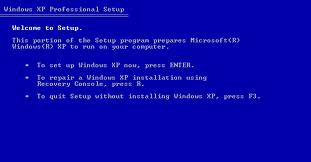 First of all, you’ll need the Windows XP CD. Next, you need to make sure that CD/DVD is the first boot device in BIOS. To load BIOS, press DEL at the startup screen (in some PCs a different button is used, for example one of the Function keys) and look for the boot device priority. If CD/DVD is not at the top of the list, select it and press the plus (+) key until it’s on top. Press F10 to save the settings and exit.
- Restart the PC and put the XP CD in the CD/DVD drive. Follow the instructions on screen (Press any key to boot from CD…)
- At the first menu, you’ll be shown a couple of options. Press R to load the Recovery Console.
- In the next window, you’ll be asked to log on to your Windows installation. Most PCs will have only one, so you have to press 1 and Enter.
- You are now in the C:\Windows directory. To see the list of available commands, type in HELP.
In my previous blog entry, I used the CHKDSK command to fix logical file system errors. From this location, you can also use FIXMBR to write a new master boot record to the hard drive or view/access subfolders with the DIR and CD commands.
Read the rest »
By admin on Dec 21, 2008 | In PC Crash | No Comments »
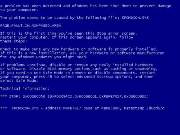 Recently I had a serious problem with my laptop. When I turned it on and Windows XP started to load, it suddenly displayed the Blue Screen of Death (BSD) and restarted itself. I tried to boot into Safe Mode (press and hold F8 until you see the menu) but it stopped with a message: ‘press Escape to stop loading d346bus.sys’. When I pressed Escape, the laptop rebooted again. I tried other options on the menu (last known good configuration, safe mode with cmd and networking) with the same result. The BSD appeared only for a fraction of a second and after several attempts to read the message, I saw that Master_Boot_Volume was listed.
No new hardware or software was installed recently and I didn’t suspect a virus infection. d346bus.sys file is part of Daemon tools and I would have uninstalled the program if I had a way to load Windows XP.
I attempted to repair the Windows XP installation by using the XP CD, however no previous Windows installation was found, so there was nothing to repair. I was already thinking about formatting the hard drive as I thought I had lost everything…
Read the rest »
